



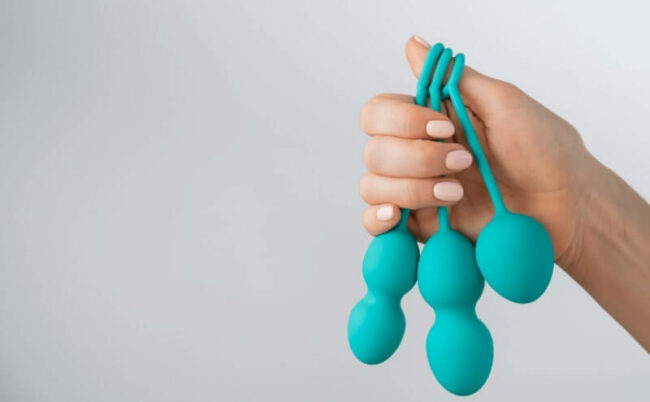

Geisha balls are small weighted balls linked together that you insert into the vagina. Whether you’re postpartum or not, they’re very useful for pelvic floor training. Geisha balls come in a range of materials, weights and sizes to suit every need.
Here are the 3 key points to remember from this article:
- Principle and how they work: Geisha balls engage the pelvic muscles through gravity and passive resistance, helping to tone the pelvic floor.
- Precautions and limits: If they’re used incorrectly or chosen when they’re too heavy, they can lead to hypertonicity or worsen incontinence in a weakened pelvic floor.
- Biofeedback and precision: For active, measurable and safe training, the connected Emy Trainer pelvic floor trainer offers personalised support that’s medically validated.
What are Geisha balls and how do they work?
Geisha balls, historically called Ben Wa balls, are small spheres usually made of medical-grade silicone, inserted into the vagina. Most modern models contain an internal metal ball that moves with each of your movements. This movement creates slight vibrations that trigger involuntary reflex contractions in the muscles of the pelvic floor.
The main goal is to train muscle tone against gravity: to keep the ball in place when you’re standing or moving, your muscles need to maintain continuous pressure. Geisha balls are available in different weights (from 28 g to more than 85 g) and diameters, so they can gradually match each woman’s muscle strength.
What are the benefits of Geisha balls for the pelvic floor?
When they’re included in a suitable exercise routine, Geisha balls offer several benefits for intimate health:
- Firmer pelvic muscles: By adding weight to your contractions, they increase the challenge during Kegel exercises and help improve muscle tone.
- Prevention of mild urinary leaks: A toned pelvic floor provides better support for the bladder and urethral sphincter during everyday efforts (coughing, laughing, physical activity).
- Improved intimate sensations: Toning the vaginal canal and increasing local blood flow can help intensify pleasure during sex.
- Greater body awareness: Feeling the accessory’s presence helps some women locate the pelvic floor area more easily and learn how to contract it correctly.
Using Geisha balls to treat urinary leaks
Let’s focus on urinary leaks now. How can Geisha balls help reduce this problem? Quite simply by greatly increasing the effectiveness of Kegel exercises.
These exercises help strengthen the pelvic floor muscles through a sequence of contractions and relaxations. Over time, pelvic floor training gives you better control over the urethral sphincters.
When you do your exercises with Ben Wa balls, you move up to a higher level of difficulty. In other words, your pelvic floor gets even stronger by squeezing the balls in different ways. As a result, your sessions become more effective for reducing urinary symptoms.
Are there any risks or contraindications?
Contrary to popular belief, Geisha balls aren’t suitable for every woman or every stage of intimate life. It’s essential to understand the concerns and contraindications raised by physiotherapists and midwives:
- Risk of muscle hypertonicity: Wearing balls for too long (more than 30 minutes) forces the pelvic floor to stay contracted continuously. This can cause spasms, pelvic pain or hypertonicity.
- Muscle fatigue and worsening leaks: If the weight chosen is too heavy for your muscle’s initial strength, the pelvic floor loses grip and relaxes completely, increasing the risk of stress urinary leaks.
- Contraindicated immediately after childbirth: Never insert heavy accessories into the vagina before the postnatal check-up (6 to 8 weeks after birth) and approval from a healthcare professional. Using them too soon may encourage pelvic organ prolapse.
- Infections and hygiene: Inadequate cleaning with a gentle intimate soap before and after each use can disrupt the vaginal flora and cause thrush or cystitis.
Kegel balls, Geisha balls, yoni eggs: what’s the difference?
The terms Kegel balls, Geisha balls, Ben Wa balls and yoni eggs are often used as synonyms. But they actually refer to different accessories, with different uses, materials and levels of reliability.
Kegel balls and Geisha balls: almost synonyms
Historically, Geisha balls (or Ben Wa balls) referred to small solid spheres used for pleasure. Kegel balls are their modern evolution, designed for pelvic floor training: they’re weighted, often connected by a removal cord, and sometimes linked together to create a slight vibration with every movement. Today, most manufacturers use both names for the same product.
Yoni eggs: a different object
Yoni eggs come from an Eastern wellness tradition (jade, rose quartz, obsidian). Unlike Kegel balls, they’re carved from stone, without a removal cord in traditional versions, and they aren’t designed as training devices. Gynaecologists regularly warn about three risks: the stone’s porosity (bacterial adhesion), difficulty removing it, and the absence of any medical follow-up.
Materials: what really changes
The material determines how safe it is to use.
|
Material |
Balls concerned |
What you need to know |
|
Medical-grade silicone |
Modern Kegel/Geisha balls |
Non-porous, hypoallergenic, compatible with water-based lubricant. Recommended standard. |
|
ABS plastic |
Entry-level Ben Wa balls |
Rigid, may cause irritation. Acceptable if medical grade, otherwise best avoided. |
|
Natural stone |
Yoni eggs (jade, quartz) |
Porous, traps bacteria. Demanding cleaning, sterilisation by boiling recommended. |
|
Metal |
Premium Ben Wa balls |
Non-porous and heavy. Effective for an already toned pelvic floor, not very suitable for beginners. |
Progressive weights: how to choose
Weight determines the level of resistance. A weakened pelvic floor (postpartum, age, menopause) shouldn’t start with a heavy weight: the muscle would relax instead of contracting.
- Beginner or postpartum (after official pelvic floor recovery): 30 to 50 g.
- Intermediate level: 60 to 80 g.
- Already toned pelvic floor: 90 to 100 g and above.
Many kits offer adjustable weights — interchangeable internal balls — so you can progress without having to buy a new accessory.
The steps for using Geisha balls
Chinese balls are a great accessory for gently strengthening the pelvic floor muscles. But you still need to use them correctly. Otherwise, the results could even be the opposite of what you expected…
So let’s start with the main steps for using this accessory:
- First, wash your hands with warm soapy water before you begin.
- Likewise, thoroughly clean your Geisha balls with gentle intimate soap and lukewarm water. Then dry them well.
- Apply a small amount of water-based lubricant to each ball to make insertion easier.
- Lie down or stand up. Further down in this article, we’ve dedicated a section to choosing the best position.
- Do your Kegel exercises by contracting your pelvic floor around the balls, then releasing.
- When you’re done, remove the accessory by gently pulling the loop on the outside.
- Finally, wash and dry your Geisha balls again before storing them in a closed container.
You’ll notice that good hygiene is especially important throughout the process!

How do you position Chinese balls correctly?
Now that you know the overall method, let’s look at another essential point: positioning the balls. Yes, if you don’t place them correctly, you won’t get results. Worse, you may even feel discomfort or pain…
Whether you’re using Geisha balls with adjustable/variable weights or fixed weights, the positioning is the same. Once inside the vagina, they should sit just above the pelvic floor muscles. No higher. That’s the level at which your pelvic-floor contractions will be able to lift the balls during Kegel exercises.
For comparison, the balls sit lower than a tampon. The lowest ball should be 3 to 5 cm from the vaginal opening. And the removal string should stay outside.
If in doubt, you can even ask your midwife to help you place them correctly.
Which positions should you use for Kegel exercises with balls?
Next, the second point to pay attention to is your own position. In other words, what will be the best position for doing your Kegel exercises with Geisha balls?
The short answer: the one in which you feel most comfortable! And the longer version: it depends on your level and the strength of your pelvic floor muscles.
So, the lying-down position is ideal if you’re starting Kegel exercises and/or using Geisha balls. Likewise, it’s best to begin lying down if your pelvic muscles are weak. This way, you’ll better feel the sensations and the exercises will be easier. In fact, your pelvic floor won’t have to fight against gravity. It will only need to “lift” the balls inside the vagina.

By contrast, the standing position is best for strengthening your pelvic floor even more deeply (and still gently). Its muscles will then need to work harder to lift the balls inward/upward. What’s more, this is the natural position in which the pelvic floor works in everyday life. Standing Kegel exercises therefore provide training in real-life conditions.
With that in mind, if you’re using Geisha balls for pelvic floor recovery, start lying down. Then increase the challenge by moving to standing. Sitting is also an interesting intermediate option for a smoother transition.
Tips for using Geisha balls for pelvic floor recovery
Now, let’s get practical. How do you do Kegel exercises with Geisha balls to strengthen the pelvic floor muscles?

Whether you’re 20, 30, or older, here’s the basic technique:
- Get into position and place your intimate accessory inside your vagina.
- Gently contract your pelvic floor by squeezing the Chinese balls. Imagine you’re trying to press them together.
- Then contract your muscles from the vaginal opening inward, to lift the balls upward. If you do it correctly, you’ll notice the removal string pulling slightly into your vagina.
- Then gently relax your pelvic floor. You’ll feel the Geisha balls move back down and return to their initial position.
- Take time to rest and relax your muscles before contracting them again. In Kegel exercises, the pauses are just as important as the effort.
Finally, if you feel the balls slipping out of your vagina during the exercises, improve your technique. Correct execution means squeezing them and lifting them back up inside.
Strengthen and tone your pelvic floor progressively
Based on this exercise routine, it’s up to you to vary the duration and pace during training sessions — and from one session to the next. The first few times, you’ll probably get tired quickly.
Start with 2-3 contraction/relaxation cycles. Then, gradually increase the repetitions until you reach sets of 10.
For better results, also follow these tips:
- Relax your glutes and thighs throughout the exercises. Only the pelvic floor muscles should contract.
- Breathe normally as you do the exercises. There’s no need to hold your breath.
- Ideally, plan 1 to 2 training sessions per day.
In any case, don’t hesitate to ask a midwife or a specialised physiotherapist. A professional will support you as you get started, for effective and safe use of Geisha balls in your pelvic floor recovery.
Learn more about my pelvic floor
Geisha ball or smart pelvic floor trainer: which method should you choose?
Geisha balls and the connected pelvic floor trainer have the same goal — to strengthen the pelvic floor — but they are based on two very different principles. The choice depends on your starting point, your goal, and whether you need feedback.
Two opposing approaches: mechanical resistance vs biofeedback
The Geisha ball is a passive device: it provides resistance against contraction thanks to its weight, but it doesn’t tell you whether you’re contracting the right muscle, with the right intensity, or for how long you’re holding it.
The smart pelvic floor trainer relies on biofeedback: it measures your pelvic floor’s electrical activity in real time and gives you visual feedback through an app. You can see whether you’re really contracting, how strongly, and track your progress week after week.

Side-by-side comparison
|
Criterion |
Geisha ball |
Emy Trainer smart pelvic floor trainer |
|
Principle |
Passive mechanical resistance |
Active real-time biofeedback |
|
Feedback |
None (subjective sensation) |
Mobile app, contraction curves |
|
Ideal for |
Maintenance, toned pelvic floor, intimate pleasure |
Recovery, urinary leaks, postpartum |
|
Urinary leaks |
Results vary depending on technique |
Clinically proven effectiveness (Strasbourg University Hospital) |
|
Status |
Wellness accessory |
CE-marked medical device |
|
Guidance |
None |
Personalised, gamified exercise programme |
|
Indicative price |
€15 to €60 |
€165 |
What should you choose in your case?
Choose Geisha balls if your pelvic floor is already toned, you’re mainly looking for maintenance or an intimate dimension, and you already know how to isolate the pelvic floor muscles correctly.
Choose the Emy smart pelvic floor trainer if you have stress or urgency urinary incontinence, if you’re in postpartum, if you’re not sure you’re engaging the right muscle, or if you want a guided, measurable programme — that’s what our clinical study with more than 50 patients at Strasbourg University Hospital validated.
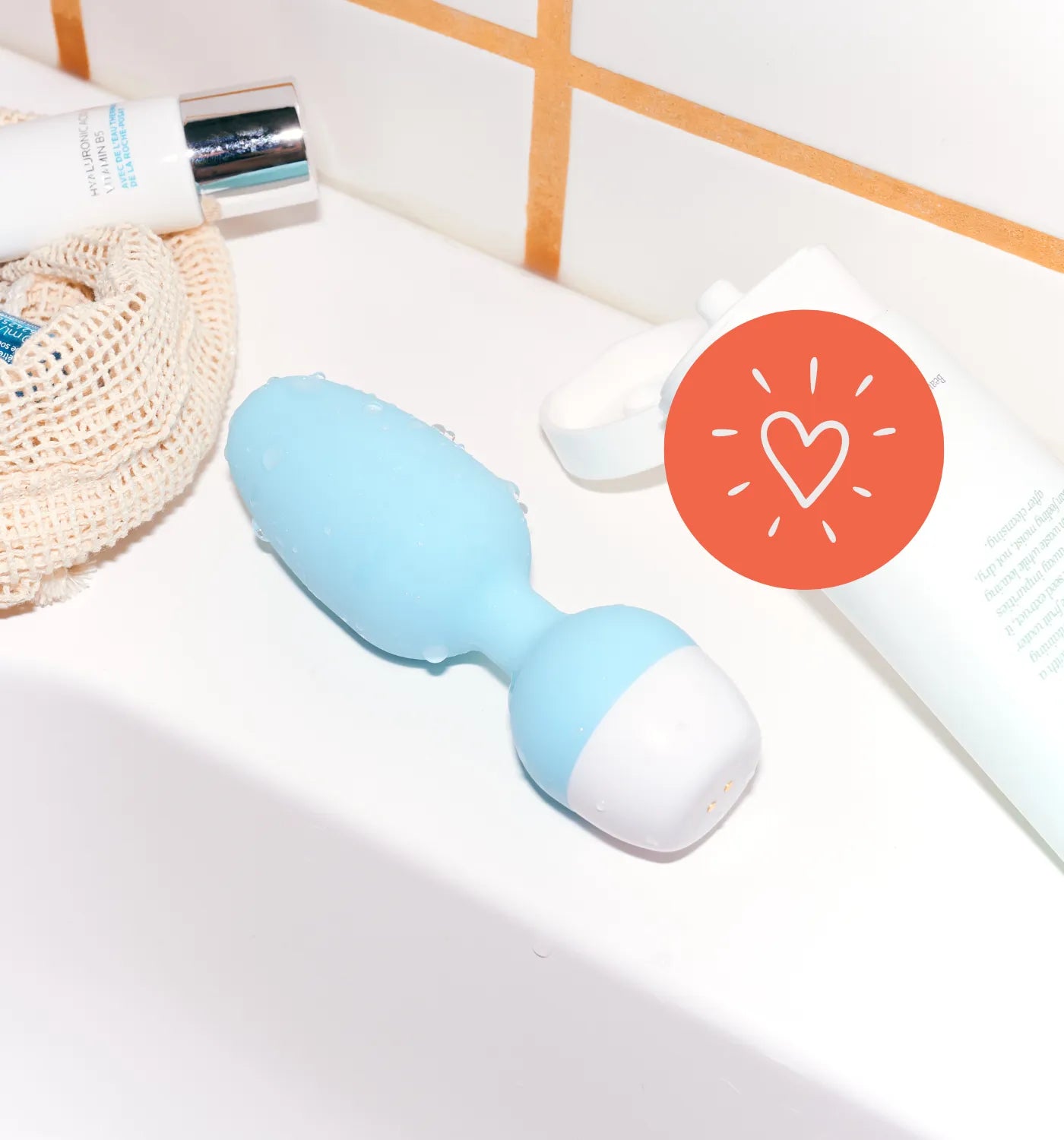
The Emy Trainer biofeedback device also makes truly personalised pelvic floor recovery possible. The exercise difficulty level is tailored to each woman and adapts according to her strength and her previous training results. This vaginal accessory then replaces Chinese balls during the contraction phase of Kegel exercises.
Choose it for a more motivating and effective pelvic floor recovery… and above all, fewer urinary leaks!
Frequently asked questions about Geisha balls
How long should you wear Geisha balls each day?
15 to 20 minutes a day is enough at the start, gradually increasing to a maximum of 30 minutes. It’s not recommended to wear them longer or sleep with them. Give your pelvic floor at least one day of rest per week.
What weight should you choose for your first Geisha balls?
If you’re a beginner or in postpartum recovery, start with 30 to 50 grams. At an intermediate level, move up to 60–80 g. Above 90 g, your muscles should already be well toned. Adjustable-weight models let you progress with just one kit.
Can you use Geisha balls after giving birth?
Not before your postnatal check-up (6 to 8 weeks) and without advice from a midwife or physiotherapist. Medical pelvic floor training should come before any weighted accessory. Using them too soon can worsen a prolapse or abdominal diastasis.
Are Geisha balls effective against urinary leaks?
They can help with mild leaks, provided you contract the right muscle. For stress incontinence or urgency incontinence, kegel exercises with a biofeedback device are more effective.
How do I know if my Geisha balls are correctly positioned?
They should sit 3 to 5 cm from the vaginal entrance, lower than a sanitary tampon. The cord stays outside. When correctly positioned, you shouldn’t feel them at rest, and you lift them with each contraction.
What’s the difference between Geisha balls and a connected pelvic floor trainer?
The ball is a passive weight: it creates resistance without telling you whether you are contracting the right muscle. The connected trainer measures pelvic floor activity in real time and guides each exercise via an app. Emy Trainer is clinically validated.
What to remember about Geisha balls and the pelvic floor
- A complementary maintenance tool: Useful for toning a pelvic floor that is already functioning well, Geisha balls should be used with caution and for short periods only (20 to 30 min max).
- Watch out for contraindications: They should be avoided immediately after childbirth, in cases of untreated prolapse or pelvic pain, as they may worsen symptoms.
- Choose biofeedback: To handle incontinence effectively and strengthen your pelvic floor safely at home, the connected trainer Emy Trainer is a suitable medical solution.
Sources:
- Prospective evaluation of the connected biofeedback EMY Kegel trainer in the management of stress urinary incontinence, Jochum F et al., February 2022, Journal of Gynecology Obstetrics and Human Reproduction 51(2):102280. - link
- Pelvic Floor Muscle Rehabilitation Using Biofeedback, Diane Kaschak Newman, July 2014, Urologic Nursing 34(4):193-202. - link
- Postpartum rehabilitation, Haute Autorité de Santé (HAS), December 2002, Clinical practice recommendations. - link