





The perineum is a set of muscles playing a key role in supporting the pelvic organs and controlling urinary and bowel functions. When it becomes loose, it can cause discomfort, including urinary leakage or a decreased muscle tone. Faced with these inconveniences, the perineal rehabilitation by biofeedback presents itself as an effective solution allowing better awareness and progressive reinforcement of this essential area of the body.
Understanding perineal biofeedback
Biofeedback is a innovative rehabilitation technique which uses sensors to measure muscle activity in real time.
This information is then displayed on a screen or translated into sound signals, allowing you to understand how your muscles react and adjust your efforts to optimize your contractions.

How does this method work?
The use of biofeedback is based on inserting a probe into the vagina or rectum, depending on the needs of each individual.
This probe detects the intensity and duration of muscle contractions, thus providing instant feedback in visual or auditory form.
Thanks to this precise monitoring, it becomes possible to correct posture and to gradually improve the quality of the exercises, which thus promotes a targeted strengthening of the perineum.
What are the benefits of biofeedback?
Progressive and effective muscle training
Biofeedback allows you to exercise the muscles of the perineum targeted manner and progressive. In addition, by providing a clear visualization of contractions, it helps you better understand your efforts and ensure exercises are performed correctly.

This approach facilitates regular training and contributes to visible results in a few weeks, as evidenced by the many users.
Better body awareness
Many people have difficulty locate and activate their perineal muscles. Thanks to perineal rehabilitation using biofeedback, they can finally see and feel the impact of their efforts!
This technique improves their ability to contract and relax these muscles with great precision. This results in a more effective and lasting rehabilitation.
Personalized rehabilitation according to needs
Each individual has specific needs in terms of perineal rehabilitation. Biofeedback allows adapt the exercises according to the level of muscle tone and personal goals.
It is thus possible to adjust the intensity and frequency of the sessions to guarantee a constant and sustainable progress.

Easy use at home
Modern and intuitive devices
Current technologies make it possible to use biofeedback in complete autonomy, at home.
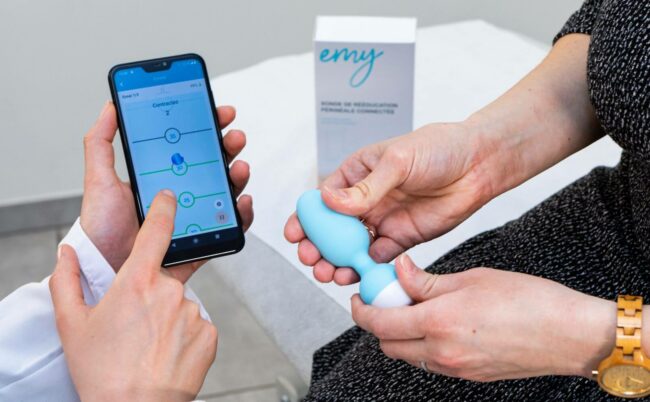
Of the probes connected to mobile applications guide the user through different exercises and track progress in real time. This interactive approach makes training more motivating and accessible.

How often for optimal results?
It is recommended to carry out sessions of 10 to 15 minutes, three to four times a week. With regular and appropriate practice, it is possible to observe significant improvements in a few weeks.
Emy biofeedback probe: an ally for perineal rehabilitation at home
In addition to sessions with a professional, Emy biofeedback probe Trainer allows you to continue your perineal rehabilitation at home, in complete autonomy.
This connected device analyzes muscular contractions of the perineum and provides a real-time feedback to the user directly on her smartphone.

Thanks to fun and personalized exercises, Emy Trainer helps to gradually strengthen the pelvic muscles. Thus, it guarantees a correct execution of movements.
Recommended by many healthcare professionals throughout the world, the Emy probe constitutes a practical and effective solution to improve the tone of the perineum and prevent disorders linked to its weakening.
Learn more about the Emy probe
Biofeedback and electrostimulation: what are the differences?
Biofeedback and electrostimulation are two complementary approaches but distinct:
- Biofeedback helps to become aware of muscle contractions and to improve their control voluntarily.
- Electrostimulation sends mild electrical impulses to cause involuntary contractions. Which can be useful for people who have difficulty mobilizing their muscles alone.

When to consult a professional?
If you experience a loss of muscle tone, urinary leakage or pelvic pain, don't wait. It is advisable to consult a specialist, such as a physiotherapist, midwife or doctor.
These professionals will be able to assess your situation and offer you a rehabilitation program adapted to your needs.

Perineal rehabilitation accessible and fun thanks to biofeedback
Perineal rehabilitation by biofeedback is a effective and accessible solution For strengthen the pelvic muscles.
This method makes it possible to become aware of muscular activity. And it allows you to adjust the exercises accordingly for targeted and progressive rehabilitation.
Used in addition to professional monitoring, the use of a biofeedback probe contributes to better muscle control. It helps to prevent various functional disorders such as urinary incontinence or pelvic pain.
You can improve your quality of life by integrating the use of the Emy Trainer probe into a suitable care routine.