





Kegel exercises are targeted exercises to strengthen your pelvic floor: simple, discreet and possible without any device. Done regularly, at home, during sport or alongside rehabilitation, they strengthen the pelvic floor muscles, which support the pelvic organs and help control the bladder.
In this article, you will find out:
- The basics: what Kegel exercises are and why they are good for your pelvic floor.
- The right technique: how to work the slow-twitch and fast-twitch muscle fibres, and how often to train.
- Possible support: how the Emy app and Emy Trainer show you whether you are activating your pelvic floor.
What is the pelvic floor and where is it?
The pelvic floor is a group of muscles and tissues that stretches from the pubic bone to the coccyx and surrounds the urethra, vagina and anus. Like a hammock, it supports the pelvic organs: the bladder, uterus and rectum.

Your pelvic floor deserves as much attention as your other muscles. When it is weak, it can lead to urinary leaks. Because these muscles lie deep in the pelvis, it is often hard at first to contract them in a targeted way. With a little patience and regular practice, the right feeling gradually comes.
What are Kegel exercises and where does the name come from?
Kegel exercises involve contracting the pelvic floor muscles, gently drawing them inwards and upwards, then releasing them in a controlled way. Over time, you gradually increase how long you hold the contraction and the number of repetitions.
They are named after the American gynaecologist Arnold H. Kegel. In the late 1940s, he observed that many women experienced urinary leaks after childbirth. He developed an exercise programme to strengthen the pelvic floor muscles put under strain during pregnancy. Today, the International Consultation on Incontinence recommends pelvic floor muscle training as a first-line approach for urinary leaks in women.
Why do Kegel exercises?
Your pelvic floor works all day long. It supports the pelvic organs and absorbs the pressure created when you jump, cough or laugh. When it is weak, leaks can occur, particularly during sport.

The pelvic floor also plays a role in your sex life: during orgasm, it contracts rhythmically. It is also put under heavy strain during pregnancy and childbirth. This is why it is worth training it regularly throughout your life.
What are the benefits of Kegel exercises?
Pelvic floor training has been the subject of many studies. A Cochrane review analysing numerous trials shows that women with stress urinary incontinence who train their pelvic floor more often report fewer symptoms and a better quality of life than those who do not (Dumoulin et al., 2018).
A toned pelvic floor also brings everyday benefits:
- better support for the pelvic organs;
- coordinated work with the abdominal and back muscles, supporting a stable posture;
- better body awareness, including during sex.
Who can do Kegel exercises?
Almost everyone, at any age: after giving birth, during the menopause, alongside high-impact sport or simply to look after your pelvic floor. If you have pelvic pain, talk to your GP or a physiotherapist first: a pelvic floor that is too tight needs to learn to relax instead.
How do you do Kegel exercises day to day?
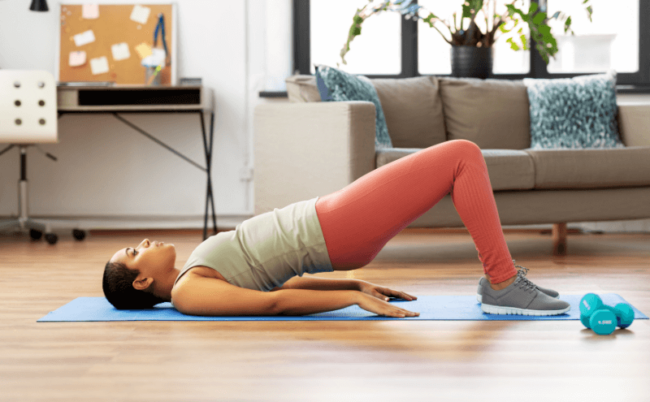
The principle is simple: you contract your pelvic floor muscles, then relax them. Nobody notices you doing it. You can train lying down, sitting or standing; at first, lying down is usually easiest.
- Find the right muscles: imagine you are holding in the urge to pass urine or wind. Actually stopping the flow of urine on the toilet can be tried once to feel the muscles, but it is not a regular exercise.
- Breathe properly: contract as you breathe out and keep breathing calmly. Do not hold your breath or push down.
- Activate only your pelvic floor: keep your abdominal muscles, buttocks and thighs relaxed. Place a hand on your tummy to check.
- Plan rest breaks: always relax your muscles for at least as long as you contracted them.
Once you have mastered the contraction lying on your back, train with your knees bent, then sitting with your back straight, and finally standing, to get closer to the everyday situations where your pelvic floor is under strain.
How often should you do Kegel exercises?
The most important thing is consistency. Train 3 to 5 times a week, for 5 to 15 minutes each time. If you like, you can also fit short sets into your day, for example while brushing your teeth or waiting at traffic lights.
Kegel exercises: how do you do them step by step?
To work your whole pelvic floor, target two types of muscle fibres:
- fast-twitch fibres react quickly to sudden pressure, for example when you sneeze or cough;
- slow-twitch fibres withstand prolonged effort, for example when you carry heavy shopping.
Exercise 1: working the slow-twitch fibres
- Lie comfortably on your back.
- Gently contract your pelvic floor and draw it inwards and up towards your belly button.
- Hold the contraction for 3 to 5 seconds while breathing calmly.
- Relax for 3 to 5 seconds.
- Repeat 10 times.
When this becomes easy, gradually increase the hold time to up to 10 seconds, lengthening the relaxation phase in the same way.
Exercise 2: working the fast-twitch fibres
- Contract your pelvic floor 3 times in a row, briefly and quickly.
- Fully relax the muscles for a few seconds.
- Repeat this set 10 times.
For support, or to vary your exercises with mini-games, you can download the free Emy app. You can also set reminders in it so you do not forget your sessions.

How can a biofeedback trainer help?
At first, it is often hard to feel whether you are really contracting your pelvic floor. Biofeedback can help: a biofeedback trainer captures your pelvic floor activity and displays it in real time on your smartphone.
Emy Trainer is a connected biofeedback pelvic floor trainer and a CE-marked medical device. It shows you whether you are activating your pelvic floor and guides you with mini-games that adapt to your level, discreetly at home.

Good to know: Emy Trainer must not be used during pregnancy or in the 7 weeks following childbirth. If in doubt, ask your doctor or midwife.
Emy Trainer was assessed in a clinical study carried out at Strasbourg University Hospital with more than 50 women experiencing stress urinary incontinence. After 3 months of using Emy Trainer, 98% of participants reported an improvement in their quality of life, and 91% an improvement in their urinary symptoms (Jochum et al., 2021).
Find out more about Emy Trainer
When should you see a healthcare professional?
Not sure whether you are contracting your pelvic floor correctly? Pelvic floor rehabilitation sessions with a midwife or physiotherapist teach you to locate your pelvic floor and avoid tensing other muscles (buttocks, abdominal muscles). If you have persistent symptoms, such as urinary leaks or pelvic pain, medical advice is important in any case.
How can you protect your pelvic floor every day?
As well as doing the exercises, remember to protect your pelvic floor in daily life. It is put under strain with every effort: when you laugh, sneeze or lift something. Before an effort, draw in your tummy, breathe out and contract your pelvic floor to brace it: this reduces the pressure on your pelvic muscles. Also discover the everyday habits that strain the pelvic floor.

Key takeaways on Kegel exercises
- Kegel exercises strengthen your pelvic floor muscles in a targeted way, discreetly, anywhere and without a device.
- The right technique (contract as you breathe out, do not push down), enough relaxation and consistency matter most: 3 to 5 times a week, for 5 to 15 minutes.
- Emy Trainer uses biofeedback to show you in real time whether you are activating your pelvic floor.
Sources
- Pelvic floor muscle training versus no treatment, or inactive control treatments, for urinary incontinence in women, Chantale Dumoulin, Licia P. Cacciari, E. Jean C. Hay-Smith, October 2018, Cochrane Database of Systematic Reviews 10(10):CD005654 – pubmed.ncbi.nlm.nih.gov/30288727
- Pelvic floor muscle training for preventing and treating urinary and faecal incontinence in antenatal and postnatal women, Stephanie J. Woodley et al., May 2020, Cochrane Database of Systematic Reviews 5(5):CD007471 – pubmed.ncbi.nlm.nih.gov/32378735
- Comparisons of approaches to pelvic floor muscle training for urinary incontinence in women, E. Jean C. Hay-Smith et al., December 2024, Cochrane Database of Systematic Reviews 12(12):CD009508 – pubmed.ncbi.nlm.nih.gov/39704322
- Prospective evaluation of the connected biofeedback EMY Kegel trainer in the management of stress urinary incontinence, Jochum F et al., February 2022, Journal of Gynecology Obstetrics and Human Reproduction 51(2):102280 – pubmed.ncbi.nlm.nih.gov/34861424