







Are you considering pelvic floor training sessions with a physiotherapist but unsure what to expect? We’ll explain everything!
- Comprehensive pelvic floor assessment during the very first session to choose the most suitable method.
- Main techniques used in the clinic: biofeedback, electrical stimulation, and manual training tailored to your needs.
- Key role of the physiotherapist: teaching you the correct contraction, correcting your posture, and offering daily advice.
- The importance of continuing exercises at home to maintain results over time.
- Biofeedback devices like the Emy pelvic floor trainer to keep up your training at home in a fun and personalized way.
Pelvic floor assessment during the first training session
The goal of this session is to assess the overall health of your pelvic floor. Using a verbal questionnaire to identify your symptoms and a manual examination, the physiotherapist will decide on the most appropriate method for your pelvic floor training.

A questionnaire to identify pelvic issues
During your first session with the physiotherapist, you’ll be asked several questions about your health status and the presence or absence of certain symptoms:
- urinary or fecal incontinence
- vaginal flatulence
- feelings of heaviness
- pain during intercourse…

A manual examination to assess the pelvic floor
At the start of your training, the physiotherapist will perform a manual examination of your pelvic floor to tailor your care. This manual testing helps evaluate the muscle condition of your pelvic floor.
The physiotherapist will also ask you to perform various types of contractions with your pelvic floor. This allows them to assess its tone, weakness, and the quality of contraction you can achieve.
I take care of my pelvic floor
The purpose of this examination is to teach you how to perform a correct pelvic floor contraction (without engaging your abs, thighs, or glutes) and to identify your pelvic floor weaknesses. This helps the physiotherapist target the treatment and adapt the training method offered afterwards.
What happens during a pelvic floor physiotherapy session? ?
Once the pelvic floor assessment is complete, your physiotherapist has a comprehensive understanding of your condition and can therefore recommend the most suitable pelvic floor training method for you.
Generally, the most commonly used techniques in physiotherapy clinics are biofeedback and pelvic floor electrostimulation.
What happens during a biofeedback training session?
The biofeedback technique is based on performing voluntary pelvic floor contractions by the patient. With this method, the patient becomes aware of the work done during their pelvic floor recovery.
Practically, a vaginal (or anal) pelvic floor trainer detects the pelvic floor contractions performed by the patient. This information is then displayed on a screen where it is possible to see the contractions in real time.
During a biofeedback training session, the patient follows contraction instructions displayed on a screen and can see in real time whether they are performing the exercise correctly.
With this method, the patient can train different types of contractions depending on the program used by the physiotherapist: repeated contractions, sustained contractions, quick contractions, and more.
Biofeedback supports active training since the patient gains a real awareness of their pelvic floor contraction and its proper execution.
This learning also encourages the development of reflex contractions to protect the pelvic floor in daily life. Towards the end of recovery, sessions can even be done standing or during physical effort such as coughing or lifting.
What happens during an electrostimulation session?
The principle of electrostimulation involves applying an electric current to stimulate the pelvic muscles. The physiotherapist programs a series of electrical stimulations that are delivered locally to the pelvic floor (using electrodes placed externally or a vaginal or anal pelvic floor trainer).
In this method, the muscle contraction is called a “reflex” contraction. This means the patient does not actively contract; it is a passive contraction.
Pelvic floor electrostimulation sessions help initiate recovery when the patient has limited awareness of their pelvic floor and struggles to perform contractions. Electrostimulation is useful for learning to better locate your pelvic floor.

What happens during a manual pelvic floor training session?
If your pelvic floor has recently experienced trauma, such as after childbirth, your physiotherapist may suggest starting your recovery with sessions manual.
In case of tears or episiotomy, the initial goal of the training sessions will mainly be to relax the pelvic floor or to massage the scar.
The Physiotherapist’s Role in Pelvic Floor Therapy
During pelvic floor training sessions, the physiotherapist plays a key role. They will be able to guide and advise you throughout your sessions on several aspects.
- Muscle training: learning how to properly contract the pelvic muscles
- Relieving tension if you experience any pain
- Behavioral retraining and posture adjustment, especially in cases of issues like incontinence
- Posture advice: to maintain good alignment and protect your pelvic floor
- Support during physical activity

The physiotherapist can also provide you with valuable information about pelvic floor training overall and answer all your questions about the pelvic floor.
I take care of my pelvic floor
By the way, if you’re looking for a physiotherapist specialized in pelvic floor training near you, we explain how to quickly identify an expert.
Continuing Your Pelvic Floor Training at Home
Once your training sessions are completed, your physiotherapist will recommend that you continue muscle exercises at home. These exercises are essential to maintain the benefits gained from your sessions at the clinic.
They will help you keep a strong pelvic floor and prevent the onset (or recurrence) of discomfort related to this area.
To do this, there are many devices available for home exercises, such as the Emy pelvic floor trainer.
Emy: A Device to Do Your Pelvic Floor Training at Home
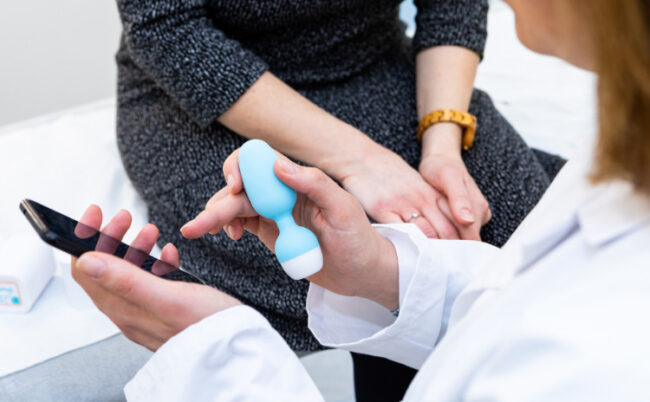
The Emy biofeedback medical device consists of a vaginal pelvic floor trainer and a mobile app. It lets you see your pelvic floor contractions live on your smartphone.
Within the app, you’ll find mini-games based on the same medical protocols used by physiotherapists in clinics.
This wireless device offers many advantages if you’re looking for a solution to continue your exercises at home.

Learn more about the Emy pelvic floor trainer
Customised Home Exercises by Your Physiotherapist
One of the main advantages of the Emy pelvic floor trainer is the customisation of your exercises by your physiotherapist overseeing your postpartum pelvic floor recovery.
Indeed, they can create tailored training sessions for you to perform at home using the trainer with biofeedback. This lets you train in a targeted way, perfectly suited to your needs directly at home.
Your physiotherapist can also personalise the exercise protocol to follow at home. Depending on your specific weaknesses, they will prioritise the type of contraction to focus on:
- long holds to maintain over time
- quick contractions to perform as fast as possible
- repetitions at varying intervals
Difficulty Level Adapted to Each Patient
When your physiotherapist selects the exercises for your programme, they can choose different difficulty levels for your training. This means your training programme will be tailored to your individual needs.
Moreover, the Emy app features smart algorithms. Even if you don’t follow a session prescribed by your physiotherapist, the exercises offered will adapt to your current muscle tone and your previous training results, helping you to keep progressing.
Learn more about the Emy pelvic floor trainer
Training in Different Positions
The Emy pelvic floor trainer allows you to do your pelvic floor exercises in various positions:
- semi-reclined or lying down
- seated
- standing

At the start of each session, the trainer is calibrated to adjust the exercise level to your pelvic floor muscle tone.
This is one of the reasons, alongside its ergonomic design, why the Emy trainer is especially recommended for all pelvic floors, even those that are very weakened.
Using the Emy Trainer in Your Physiotherapist’s Clinic
Another unique feature of the Emy system is that it can connect directly to the equipment used in physiotherapy clinics.
In fact, the Emy trainer is compatible with certain software used by physiotherapists. This allows you to use it both in the clinic with your physiotherapist and at home to complement your recovery.
It’s an excellent way to train at home between your physiotherapy sessions.
The benefits of this between-session training are twofold. You train in a targeted way at home and progress faster in your recovery.
The effects on your pelvic floor are therefore felt more quickly. This also enables your physiotherapist to go even further in customising your exercise programme during clinic sessions.
Learn more about the Emy pelvic floor trainer
A Physiotherapist’s Review of the Trainer Emy
Martine Cornillet-Bernard, former president of the AFRePP (French Association for Pelvic Floor Rehabilitation), has made pelvic floor training her mission.
It therefore seemed natural to ask her opinion on the Emy pelvic floor trainer.
« What really caught my attention with the Emy Trainer pelvic floor trainer is above all the relationship between Fizimed and therapists. They listen carefully to feedback for improving their device. They pay close attention to the signal capture as well as the training programs offered. I believe this is what truly matters. Indeed, the therapist must verify the reliability of the programs provided. The exercises are not suggested randomly. There are principles of muscle strengthening that need to be applied, and I think this ongoing exchange is essential. »
Martine Cornillet-Bernard, physiotherapist


