




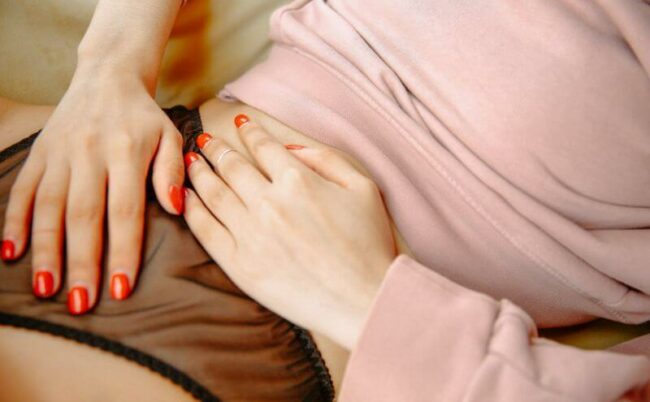

Many women experience pelvic pain. Whether chronic or acute, this pain varies in intensity and can have several origins. The main cause then needs to be identified, both to manage it properly and to relieve the pain as effectively as possible.
Where is pelvic pain felt?
Pelvic pain means pain in the lower abdomen, the pelvis and/or the pubis. Sometimes it can even radiate backwards to the buttocks or the spine, and bring on low back pain.
Although men can also experience pelvic pain, it is far more common in women.
It is worth noting that vulvar pain differs from pelvic pain. Likewise, when there is discomfort or a sensation of heaviness in the lower abdomen, we speak instead of pelvic heaviness.
What are the different types of pelvic pain?
Broadly speaking, there are two forms of pelvic pain: acute and chronic.
Acute pelvic pain
Acute pain appears suddenly and lasts less than 4 months. Of mild to severe intensity, it can be constant or intermittent.
Urinary problems (such as acute cystitis), pelvic infection linked to an STI, or ovarian torsion… Acute pelvic pain can result from very diverse problems. Here are the main ones.
Pelvic pain during pregnancy
Many pregnant women experience pelvic pain, generally diffuse and widespread.
The uterus increases in size during pregnancy, gradually compressing the organs of the urinary and digestive systems. This compression can cause pain. Likewise, the pelvis slowly changes in preparation for childbirth, which can be painful.
If you experience pelvic pain during your pregnancy, talk to your obstetrician-gynaecologist or your midwife. Suitable exercises may be prescribed to bring you relief, while maintaining the mobility needed in this area.
In addition, intense pelvic pain sometimes occurs in early pregnancy, during the first trimester. In that case, consult a healthcare professional immediately: a miscarriage or an ectopic pregnancy could be behind the pain.
In menopausal women
Menopause is also conducive to the appearance of pelvic pain. It brings major hormonal changes that alter how the whole body works.
For instance, when menopause leads to digestive problems or constipation, pelvic pain can occur. Likewise, the decline in oestrogen often causes intimate dryness of the vaginal wall, which can trigger pain.
Pelvic pain after sexual intercourse
Acute pelvic pain sometimes occurs after sexual intercourse — to be distinguished from dyspareunia, which refers to pain during the act itself. Very short-lived, it often results from involuntary muscle contractions.
However, if this pain is too frequent or bothersome, a consultation is advisable. The aim is then to rule out possible endometriosis or a sexually transmitted infection.
During the menstrual cycle
Acute pelvic pain can also be linked to the menstrual cycle. It is then cyclical pain, occurring at the same point in the cycle and with the same intensity.
Depending on the woman, it occurs before, during or after the period. Ovulation can also be painful.
Pelvic and low back pain in women
The lower back is closely connected to the digestive, urinary and genital organs. This includes the pelvic floor, more commonly called the perineum.
On one hand, the various organs are attached to the lumbar vertebrae. When these organs suffer, they can pull on the lower back and cause pain.
On the other, the nerves connected to these organs come directly from the lumbar area. So a problem in this region (lumbago, low back pain, or the link between prolapse and low back pain) can create pain in the abdomen and the pelvic area.
Chronic pelvic pain
When the discomfort lasts more than 4 months, we speak instead of chronic pelvic pain. As variable as the acute form, it can be spontaneous or not, mild to severe, constant or intermittent.
Chronic conditions and infections
Like the acute form, persistent and recurring pain has a wide variety of potential causes. But most often, chronic conditions or infections will be suspected (cystitis, constipation, chronic cough…).
After surgery, such as a caesarean section, scar adhesions can also cause chronic pelvic pain.
Such pain is also among the main symptoms of endometriosis.
Cystocele and other organ prolapses
A cystocele (descent of the bladder into the vagina) may also be the cause. Besides vaginal heaviness, this form of genital prolapse sometimes leads to difficulty urinating and urinary leaks.
The degree of severity depends on the stage of the prolapse, the fourth and final stage corresponding to a bladder that comes fully outside.
If you have the main symptoms of a cystocele, consult without delay. Pelvic floor rehabilitation may be enough to improve the situation. In the most severe cases, surgery will be considered.
What causes pain in the lower abdomen?
The causes of pelvic pain are difficult to identify. Potentially numerous, they can have varied origins and even overlap.
Let us recap the most common causes:
- genitourinary;
- gynaecological;
- digestive;
- neurological;
- muscular.
In addition, some pelvic pain is closely linked to conditions such as:
- endometriosis;
- polycystic ovary syndrome (PCOS);
- appendicitis;
- uterine fibroids.
What should you do about pelvic pain?
If you experience pelvic pain, the first step is to consult a doctor, who will guide you according to your situation.
Some causes are emergencies and require immediate care: appendicitis, peritonitis or ovarian torsion.
In every case, the healthcare professional will begin with a history-taking. This conversation helps pinpoint the type of pain, when it occurs and its potential causes.
Generally, a clinical examination — external and/or gynaecological — will follow. A vaginal examination makes it possible to identify the painful area more precisely.
If needed, further tests may be prescribed:
- a pregnancy test, to detect a possible pregnancy;
- a urine test, to make sure there is no infection;
- an ultrasound scan, to reveal cysts;
- a CT scan, to visualise the pelvic organs;
- an MRI, to look for endometriosis.
How can pelvic pain be relieved?
Depending on the cause and severity of the pelvic pain, the doctor will propose one or several solutions to relieve it. Management may be medicinal and/or surgical:
- painkillers;
- anti-inflammatories;
- medicines specific to certain conditions;
- physiotherapy sessions, in particular for pelvic floor rehabilitation;
- surgery, in the most critical cases.
Finally, whatever your pelvic pain, remember to stay well hydrated. Placing a source of heat on the area will also help ease the pain.
Sources
- Chronic Pelvic Pain: ACOG Practice Bulletin, Number 218, American College of Obstetricians and Gynecologists, March 2020, Obstetrics and Gynecology 135(3):e98-e109 – link
- Chronic pelvic pain in women: still a challenge, Pedro Vercellini, Paolo Viganò, Edgardo Somigliana, Laura Buggio, Nicola Berlanda, March 2011, BJU International 108(8):1159-71 – link
- Endometriosis, Krina T Zondervan, Christian M Becker, Stacey A Missmer, March 2020, New England Journal of Medicine 382(13):1244-1256 – link