






For many mothers, choosing an effective and comfortable breast pump is essential to continue breastfeeding, whether at home, at work or on the go. But what is a hospital breast pump ? Who is it for and how to choose the model that suits your needs? We tell you everything!
What is a hospital breast pump?
A hospital grade breast pump is a medical device designed for a intensive use. These are high-performance models designed to be used by several people, often offered for rental.
Originally, these models were reserved for health establishments to support mothers and babies in neonatology or in cases of breastfeeding difficulties.

Today, it is possible to rent or buy a hospital-grade breast pump for home use, particularly for stimulate lactation, maintain abundant production or overcome bottlenecks.
I am looking for a practical and discreet breast pump
Who is the hospital breast pump for?
Hospital grade breast pumps are intended for mothers with a medical necessity. For example, when they cannot do not breastfeed directly (baby in neonatology or with sucking difficulties, etc.) or in the event of a pathology linked to breastfeeding (mastitis…).

Expressing milk with a hospital grade machine can therefore be useful, especially for a mother who encounters difficulties during insertion or during breastfeeding. These models are recommended in several situations:
- for mothers of premature or hospitalized babies;
- in the event of prolonged separation at birth or multiple births;
- during breastfeeding difficulties (decrease in lactation, difficulty suckling, cracks, congestion…) ;
- for those who wish to relaunch or maintain their milk production in the long term;
- for moms who don't need to have their hands free or who don't need to move while expressing milk.
How long to use a hospital breast pump?
Renting a wired breast pump
In France, Social Security supports rental a hospital grade breast pump on medical prescription. Depending on the mutual, the remainder may be fully or partially reimbursed.
Therefore, the initial prescription for the rental of this type of device is limited to 10 weeks, in order to monitor breastfeeding and prevent early cessation.

This prescription can then be renewed as many times as necessary, each renewal being limited to a maximum duration of three months, as long as the need for breastfeeding is justified by a new medical prescription.
What are the disadvantages of fixed breast pumps?
The main disadvantage of hospital breast pumps is that they are wired, often very bulky and available only for rental (or very expensive to purchase).

Many mothers therefore buy a personal breast pump after 1 to 2 months of use, generally when they have well established their lactation.
I am looking for a practical and discreet breast pump
Hospital or portable breast pump: what to choose?
Comparison of breast pumps
To guide you in your choice, here is a summary table of what distinguishes hospital breast pumps (available for rental) domestic breast pumps (available for purchase for personal use).
Performance 🔋
The hospital breast pump is designed for intensive and/or medical use, adapted to the specific needs of situations requiring effective and prolonged stimulation.
On the other hand, the domestic breast pump is suitable for occasional or regular use, but not intensive, ideal for less demanding needs.
Use 🔌
A hospital device is recommended for initiate, amplify or maintain lactation, especially when the baby cannot breastfeed or in the event of a pathology.
The domestic breast pump, for its part, is ideal for classic daily needs, there return to work or the occasional expression of milk.

USAage🔌
The hospital breast pump is often used in multiple, shared between several mothers, and is usually available for rental through hospitals or pharmacies.
The domestic breast pump is intended for individual use And sells online or in childcare stores.
Technology ⚙️
Hospital machines integrate advanced technologies with varied stimulation modes and a systematic double pumping for optimal efficiency.
Domestic models offer a single or double pumping with varying functionalities depending on the model chosen.
Hygiene ✅
Designed to be shared, hospital breast pumps require personal kits for each user in order to guarantee impeccable hygiene.
Domestic breast pumps are designed for single use, exclusively by one person.
Portability 👝
Hospital breast pumps are often bulky, transporting them can be complicated, and some models require a power outlet to operate.
Domestic breast pumps are generally lighter, easy to transport (and therefore more suitable for travel) and they allow you to have hands free.

I am looking for a practical and discreet breast pump
Price 💰
The hospital breast pump is more expensive and often available only for rental.
On the other hand, the domestic breast pump is less expensive to purchase and offers a wide price range to fit different budgets.
How to choose your breast pump?
Generally speaking, whether wired or portable, a multitude of models exist. Here are some important features and criteria, among others, which you should pay attention to when choosing your breast pump:
- Favor a hospital suction power (up to 300 mmHg), close to the baby's natural sucking rhythm.
- Choose a model that offers different sizes of breast shields to adapt to all body types. It is an essential (but often underestimated) element for maximize the efficiency of your draw.
- Make sure you have various stimulation modes and several adjustable intensity levels.
- Opt only for medical grade materials, BPA free and easy to clean.
To know all the criteria to take into account in the choosing your breast pump, do not hesitate to consult our detailed guide on the subject.

What does “hospital power” mean?
The term “hospital power” designates a high suction capacity, but to date there is no no official standard.
When you purchase a hospital power breast pump, this does not necessarily mean that the breast pump is quality or hospital grade.
It is important to differentiate between the two: only models specifically designed for multiple and medical use are qualified as hospital breast pump. This is therefore the case for all models offered for rental.

Furthermore, some standard electric models intended for individual use can be efficient and called “hospital power” when their power close to that of hospital models (300mmHg). But they do not always offer the same functionalities as wired hospital models.
High-performance portable breast pump
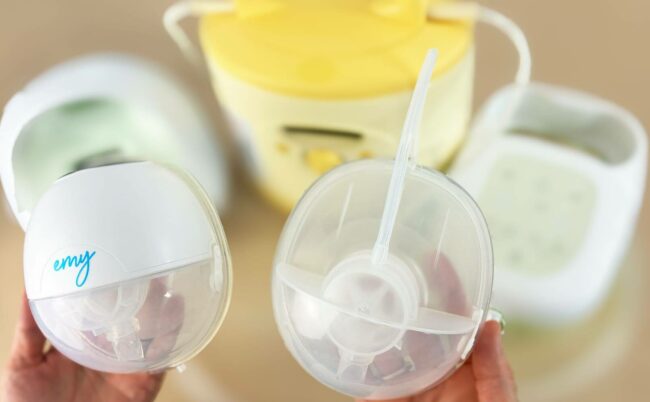
In recent years, the technology has evolved a lot. Now, some portable breast pumps, like the hands-free model Emy Pump, offer a hospital power, while remaining compact, lightweight and wireless.

The model of portable breast pump Emy Pump propose :
- up to 300 mmHg suction, 3 suction modes and 9 intensity levels;
- 7 breast shield sizes in soft silicone to adapt to each mother;
- great discretion and autonomy of 2h30, ideal for expressing milk in complete freedom, even on the go or in the office;
- easy maintenance, few parts to assemble/disassemble and they are all dishwasher safe.
Also, one of these main assets is that it is compatible with the majority of models available for rental.

In fact, the milk collector of the Emy Pump breast pump transforms into hands-free collection kit which you can plug directly into your corded machine to express your milk, hands-free!
The Emy Pump model therefore combines the performance of a hospital model to the practicality of a portable device, acclaimed by many mothers for its simplicity and effectiveness.
To conclude, breast pumps, whether hospital grade or portable, are valuable companions for mothers who wish to continue breastfeeding in the best conditions. Their use is also very often complementary.
A hospital grade breast pump will perform better, ideal for medical situations or intensive expression needs. It is designed for shared use and available for rental.
Domestic models, such as the portable breast pump Emy Pump, is designed for individual use, more affordable and transportable.


