




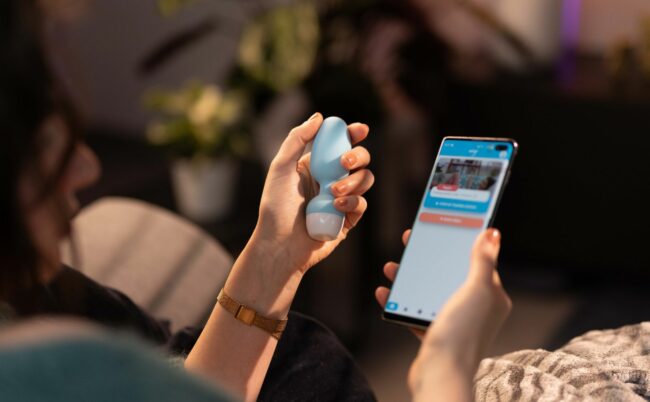
Training and maintaining your pelvic floor is essential for your well-being and quality of life, whatever your age. Today, we’re sharing Odile’s review of our Emy Trainer pelvic floor trainer. She decided to take action at 70 to strengthen her pelvic floor after noticing “a few drops of urine leakage when sneezing”. A determined and self-kind approach that also shows it’s never too late to start postpartum pelvic floor recovery!
The key points of Odile’s journey:
- A wake-up call at 70: Faced with the appearance of mild stress urinary leakage when sneezing, Odile chose to take care of herself and actively work to strengthen her pelvic floor.
- Ongoing medical follow-up at home: Initially referred to a midwife by her GP, she continued her training independently thanks to a connected device.
- Concrete, fast results: By training regularly several times a week, she noticed a clear improvement and a significant reduction in her symptoms in just three weeks.
A turning point that transformed her daily life
“I haven’t been pregnant, so I had never done any specific training on how the pelvic floor works,” she tells us.
After talking about her small urine leaks with her GP, Odile was referred to a midwife to start pelvic floor training.

This first step made her realise how important these muscles are, even though they’re so often forgotten.
To go further, her midwife recommended continuing her exercises at home with the connected Emy Trainer pelvic floor trainer.
Pelvic floor training at home with Emy Trainer
“Following Dr Bruno Deval’s book, I therefore bought the Emy Trainer pelvic floor trainer, which I’ve been using for the past 3 weeks. It’s really simple and enjoyable to use.”
The Emy app is intuitive and fun. It offers more than 32 exercises based on medical protocols, making it possible to adapt each training session to your progress.

Concrete results and stronger motivation
“I’m making progress and I practically no longer leak when I sneeze.”
In just three weeks, Odile is already noticing positive changes in her daily life.
Her routine? Using Emy Trainer 3 to 5 times a week, to stay consistent without it feeling like a chore.

She also describes these sessions as “an intimate appointment that brings a great deal of well-being”. This me-time, shaped by varied exercises and appealing visuals, becomes a source of pleasure and motivation.
And for even more variety, Odile tells us enthusiastically: “I’d even like new exercises to make the experience even more enjoyable.”
Breaking the taboo around urine leaks
Talking about urine leakage is never easy, especially when you wrongly think you’re the only one affected.
And yet, like her, many women can be affected, even without a previous pregnancy, and at any age.

“I should point out that I haven’t been pregnant,” she reminds us. Her story proves that there’s no age limit for taking care of your pelvic floor and that it’s possible to take action, whatever your journey.
With Emy Trainer, retraining your pelvic floor becomes truly simpler and more engaging. And what was once an embarrassing, taboo problem becomes a positive project to rebuild confidence in your body.
An investment in yourself, at every stage of life
Why choose Emy Trainer to strengthen your pelvic floor? Quite simply because it’s a reliable medical device, safe and designed to last: rechargeable and with clinically proven efficacy.

But also because it turns pelvic floor training into an enjoyable and motivating habit. “Easy, enjoyable, motivating,” Odile sums it up in three words.
A strong pelvic floor is a valuable ally: to help prevent or reduce urine leakage, improve quality of life and even boost self-confidence. And that applies throughout life.
“Go for it! Don’t hesitate!”
Odile’s opinion of the connected Emy Trainer pelvic floor recovery trainer is clear: “Go for it! Don’t hesitate!”
Because beyond being just a device, it’s also about the desire to take care of yourself and stay active and at ease, at 70 just as at 30!
Discover more testimonials from our users here!
Sources:
- Prospective evaluation of the connected biofeedback EMY Kegel trainer in the management of stress urinary incontinence, Jochum F et al., February 2022, Journal of Gynecology Obstetrics and Human Reproduction 51(2):102280. - link
- Pelvic Floor Muscle Rehabilitation Using Biofeedback, Diane Kaschak Newman, July 2014, Urologic Nursing 34(4):193-202. - link
- Pelvic floor training in the context of postpartum recovery, Haute Autorité de Santé (HAS), December 2002, Clinical practice recommendations. - link