





After giving birth, a young mother is usually prescribed pelvic floor training in 10 sessions with a professional. But in reality, it is possible and even preferable to strengthen the pelvic floor throughout life. The best way: do Kegel exercises every day. And if you find your sessions boring, why not try biofeedback for your pelvic floor!
Biofeedback Device for Pelvic Floor Rehabilitation
Fizimed has chosen to develop a vaginal rehabilitation probe with biofeedback with a major goal in mind: allowing every woman to take an active role in her pelvic floor rehabilitation sessions.
Alright, that’s a great goal. But concretely, what is biofeedback? In general, biofeedback is a technology to measure and visualize voluntary muscle contractions using a device.

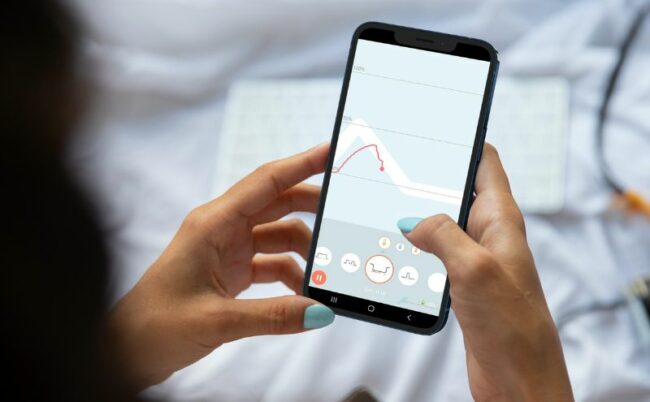
In the case of the Emy kegel trainer, biofeedback allows the visualization of pelvic floor contractions on a smartphone. Everything is done through the mobile app that communicates directly with the probe via Bluetooth.
In other words, the sensors of the Emy trainer record pelvic contractions and relaxations. Then they transmit them to the app, which displays them on the phone’s screen.

Benefits of Biofeedback for the Pelvic Floor
You now understand how biofeedback works. Now, is it really effective for regaining a toned and performing pelvic floor? The answer is yes!
And here are the numerous benefits you can expect from pelvic floor rehabilitation using a biofeedback probe.
Proven Effectiveness
First, user experiences with biofeedback probes show extremely positive results. Generally, results are felt quickly, as early as 2-3 weeks of use.
In addition, a large part of pelvic floor rehabilitation sessions with physiotherapists and midwives includes the use of biofeedback devices. This technology has proven its effectiveness and is endorsed by healthcare professionals and rehabilitation specialists.

In scientific literature, biofeedback is described as the most effective method for pelvic floor rehabilitation.
It is therefore natural that Fizimed chose this method during the development of its Emy device. Furthermore, the clinical study specifically conducted on the Emy kegel trainer demonstrates that:
- 98% of women experience an improvement in their quality of life after 3 months of using Emy;
- 87% of women see a reduction in the frequency and severity of their urinary symptoms;
- 91% of patients feel an improvement in their incontinence symptoms after only 3 months of using Emy
Active rehabilitation
Secondly, biofeedback allows you to monitor the voluntary contractions of your pelvic floor muscles. By focusing your attention on your perineum, you gradually regain control of your body.
Thanks to this innovative and patented technology, you can visualize your contractions and progress in the Emy mobile app. In short, you become an active participant in your health!

Throughout the sessions, you will regain your continence functions, improve your posture and better tone your abdominal belt. In short, your whole body benefits!
Long-term pelvic floor strengthening
Furthermore, biofeedback effectively helps to combat urinary leaks and prevent them in the long term. This is done actively, to emphasize once again that it is one of the most important aspects of pelvic floor rehabilitation through biofeedback.

Indeed, it helps you become aware of your muscle strengthening in real time. And most importantly, it teaches you to locate and control your pelvic floor by yourself.
With biofeedback, you are active during the sessions, but also and above all in your daily life.
Thus, if you have leaks when sneezing, for example, biofeedback will teach your brain to anticipate the contraction. You will then be able to laugh out loud, cough, and sneeze freely!
An accessible and sustainable solution
Finally, biofeedback is an accessible solution that offers long-lasting results for the perineum. As long as you are regular and serious in your sessions… But this should not be too problematic, thanks to this fun method!
Specifically, the regularity of the exercises ensures an optimal rehabilitation. Indeed, urinary incontinence can return despite sessions with your healthcare professional.
Do not forget that the perineum is a group of muscles that need to be trained regularly. At the first signs, resume pelvic strengthening exercises, with a probe at home or at your practitioner’s.
Which pelvic floor biofeedback trainer should you choose?
Let’s go back to Fizimed’s unique solution and its Emy, biofeedback based pelvic floor trainer. The advantage of this medical device: its sensors.
Distributed throughout the entire probe, they ensure a reliable and highly sensitive measurement of perineal contractions. The sensors can then send this data in real time and with great precision to the mobile application.

This way, you visualize your efforts live and see your real progress on your phone.
Moreover, the extreme sensitivity of the sensors allows for even more precise personalized exercises. For a better adaptation to your needs and level.
So, try to improve your pelvic floor training : you will have great feedback!