




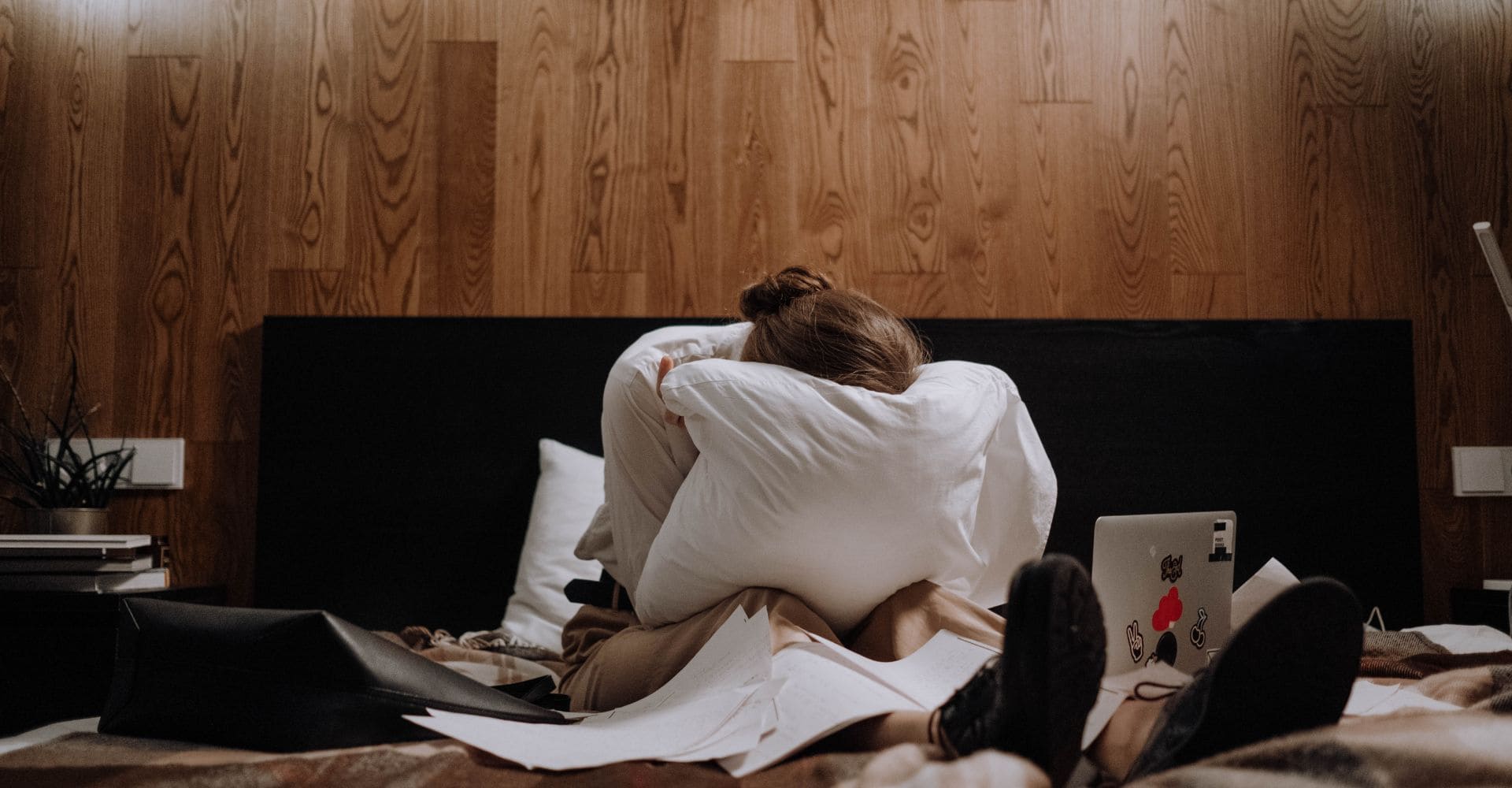

Entering menopause can feel like an emotional tsunami. Even though it’s a natural stage of life, common to every woman and an unchanging part of the life cycle, menopause can still be deeply destabilising. Between the taboo that surrounds it, the unflattering way we perceive its symptoms and the fear of an irreversible shift, it’s not easy to feel at peace with it. Let’s take a closer look at the psychological impact menopause can have.
Amenorrhoea as menopause approaches
Bye-bye periods!
Of course, menstruation can be a real nuisance. If you’ve ever cursed painful periods that show up at the worst possible time, or leave an unsightly stain, you’re certainly not alone.
Yet, apart from childhood, periods stay with us for life. We’re conditioned to see their stopping as a sign that something’s wrong, or as something out of the ordinary, such as pregnancy.
What does it mean when periods stop at menopause?
And pregnancy is exactly what we’re talking about. In principle, when periods stop, it means the woman is pregnant. But when periods stop at menopause, it means the opposite, because it implies you will never be able to have children again.
When menopause happens at the average age of the mid-fifties, there’s nothing surprising about it. Even so, coming to terms with the permanent end of your ability to conceive doesn’t happen in the same way for everyone.
This is especially true for those who have a complicated relationship with motherhood. That’s even more the case if there’s a history of trauma, pregnancy loss, or miscarriage, for example.
The age of menopause
No matter our background, nationality or personal story, we are all destined to go through menopause.
Of course, some women fall outside the usual pattern, but for the vast majority, menopause will come knocking around the age of 51.
With it, everyday life as you’ve known it for years is turned upside down.

The psychological impacts of menopause
menopause
Depression and menopause
According to a report by the Swiss Health Observatory (Obsan), women are twice as likely as men to experience a depressive episode during their lifetime.
According to Professor Patrice Lopes, chair of the study group on menopause and hormonal ageing: « Between 10 and 15 % of women in premenopause would suffer from depression ».
It is therefore important to keep an eye on the fine line that separates a low mood from a genuine depressive episode.
The impacts linked to hormonal changes
The other psychological impact of menopause comes from a physiological phenomenon: hormonal fluctuation.
Mood swings, irritability, melancholy and low spirits are in fact backed by a scientific reality. Added to this are sleep disturbances, partly due to night sweats and hot flushes.
Intimate problems and loss of self-confidence
Dry mucous membranes, muscle loss, and hormonal relaxation of the pelvic floor also add to the mix.
They can be the cause of many intimate discomforts, ranging from a simple lack of vaginal lubrication to urinary leakage, the severity of which can be disabling in everyday life.
Generally, the culprit is our pelvic floor. This group of muscles relaxes with age and tissue ageing.
It is also important to do exercises regularly to keep a toned and healthy pelvic floor.
Weight gain and sedentary lifestyle
When it comes to appearance, weight gain in menopausal women is estimated at around 4 kg.
This weight gain does not happen all at once when you stop having periods; it has already started after the quarantine, because menopause is not the only factor at play; ageing is too, along with a more sedentary lifestyle.
Let’s not forget that exercise and a balanced diet are the keys to a healthy body.
Accepting yourself despite the changes
At menopause, you no longer have the same energy as before, and neither do you have the same figure, since the body eliminates fat less easily and stores it around the stomach and hips.
You could almost hear Cristina Cordula exclaim: “My darling, you’re an H!” before adding “you are sublime”, and that’s really what matters. Let’s remember that, even if your body is no longer the one you had at 20, menopause does not make it undesirable.
It’s mainly in your head and, more specifically, it’s about taking a step back, understanding that you can stay in control of yourself despite the hormonal changes and psychological impact menopause can have.

Finally, the irreversible nature of menopause can be a source of anxiety. However, it’s important to remember that we are made to move forward, not to go backwards.
Menopause takes us out of a comfort zone we’ve grown used to, but with it opens up a new blank page to write on. It’s up to you, then, to write the beautiful stories that await you!


