






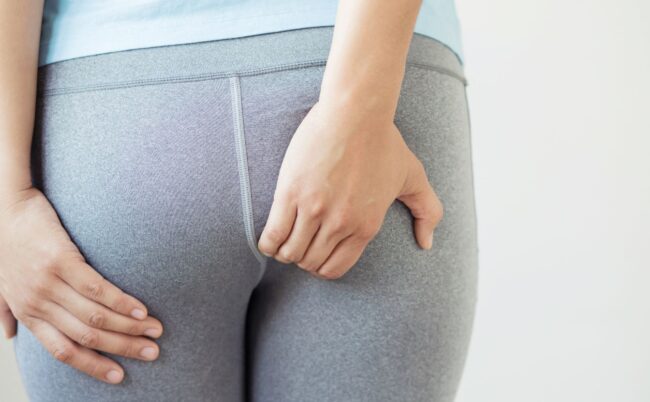

Prolapse. A word that sounds like it was borrowed from a Harry Potter spell! Far from being magical, it hides a reality that is often ignored: either because people don't want to see it, or simply because they are unaware of this condition. To protect yourself from it and understand everything about anal prolapse, let's look at the options available to us.
Detecting an anal prolapse
To fight your enemy, you must know them. A mantra borrowed from The Art of War, which applies well to the duel pitting women against prolapse. Between 11 and 19% of them are likely to face this health issue during their lifetime.
So what exactly are we talking about? About a pelvic organ prolapse, as prolapse is commonly called. It manifests as the downward sagging of the organs in the pelvic area (the bladder, the rectum and, more rarely, the uterus).
The different types of prolapse
There are different types of prolapse depending on the organ involved. We then talk about:
- rectocele for a rectum prolapse;
- Hysterocele for a uterus prolapse;
- cystocele for a bladder prolapse.

When the prolapse descends through the anus, we talk about anal prolapse. Concretely, one or more genital organs literally exit the body through the anus (usually the rectum).
Similarly, prolapse can also be vaginal when organs slip through the vagina. Vaginal and anal prolapse are two distinct conditions but can have similar pelvic organ prolapse symptoms.
When can you suffer from anal prolapse?
Anal prolapse can occur during the different stages of a woman's life. This is particularly true for multiparous mothers, for physiological reasons: the internal organs are put through the mill by successive pregnancies.

The same applies to menopausal women, this time for hormonal reasons related to pelvic floor relaxation. In the case of anal prolapse, the pelvic floor muscles that support the rectum weaken, causing a sensation of pressure or sagging.
Certain high-gravity-impact sports add a risk factor, as do nutritional deficiencies, obesity, or a difficult delivery.
A surgical operation performed in this area of the body is also sometimes the cause of a prolapse.

What are the symptoms of anal prolapse?
The symptoms of a possible prolapse are: lower abdominal discomfort, a feeling of pelvic floor heaviness, or even the sensation of a bulge in the vagina.
There may be urinary difficulties (urinating with an interrupted stream, for example) or, in the most serious cases, pain, sometimes a sign of organ protrusion.

What exams to detect a prolapse?
Beyond these signs that raise a flag, a gynaecological examination allows the diagnosis to be made with certainty. An additional vaginal examination, and sometimes a rectal examination, help assess the severity of the prolapse.

Depending on the conclusions, a urodynamic assessment may be prescribed to the patient, to prevent urinary incontinence associated with the correction of the prolapse.
Urine analysis and MRI are also on the list of medical exams potentially leading to a surgical operation, when conservative measures are not enough.
Preventing, easing or treating an anal prolapse
Strengthen your pelvic floor to prevent prolapse
To reduce, upstream, the threat of prolapse, it comes down to training your pelvic floor. Ladies, let's put our trust in our famous "hammock".

Thanks to a toning of this muscle group that holds the pelvic organs in place, we have, logically, a better chance that they stay in the original place nature assigned them.
For this, you can turn to a healthcare practitioner, or to a physiotherapist specialising in pelvic floor medicine.
Visualisation techniques for the pelvic floor
In addition, it is possible to exercise your pelvic floor by practising visualisation methods, such as the cave-and-drawbridge technique, which aims to picture the opening and closing movements of our vagina.
This option has the advantage of being doable at home without requiring any equipment, but it does have its limits.
Strengthening your pelvic floor against heaviness
Another alternative to practise at home: pelvic floor rehabilitation with a connected probe. This solution is based on the biofeedback principle; this type of rehabilitation requires the woman to contract her pelvic floor.

The probe acts as a sensor that detects muscular effort and sends a signal to the paired mobile app so you can see the contractions in real time. Enough to launch rockets with your pelvic floor, no less!
The app offers different worlds for training, playful or more medical. And the exercises are actually based on medical protocols delivered in the form of about thirty games.
Adapt your lifestyle
This pelvic floor rehabilitation is also good to practise if the prolapse is already there, but it is neither too advanced nor too severe. Rehabilitation then allows the patient to avoid complications.
These efforts should be combined with weight loss when there is excess weight, as well as with adjusting your sporting activities, favouring sports that are gentle on the pelvic floor, such as swimming.
Other alternatives to manage anal prolapse
Wearing a pessary
Besides these lifestyle changes, you can turn to medical help: the pessary.
This device is designed to compensate for the weakness of the pelvic floor, but its intravaginal placement can be uncomfortable for long-term use and it is generally recommended as a transitional solution.

Mesh placement
To manually put back in place the organs affected by a prolapse, there is the operative method known as mesh placement, where the meshes are positioned on the woman's organs via abdominal surgery.
More rarely, the healthcare practitioner chooses to position a prosthesis vaginally. Both types of operation can be performed either by a urologist or by an obstetric surgeon.
More common than one might think, anal prolapse sometimes takes time to show up with identifiable symptoms. So be, as much as possible, consistent with your annual appointments with your healthcare professional. The best monitoring in this area remains listening to your body and to anything that may abnormally change from the ordinary.
Source
- Prolapsus et statique pelvienne, Nizar Kaafarani (Gynécologie Tarbes - Polyclinique Ormeau), Septembre 2026 (Consulté), Fiche d'information médicale (gynecologie-tarbes.com).


